Keyboard shortcuts:
N/СпейсNext Slide
PPrevious Slide
OSlides Overview
ctrl+left clickZoom Element
If you want print version => add '
?print-pdf' at the end of slides URL (remove '#' fragment) and then print.
Like: https://wwwcourses.github.io/...CourseIntro.html?print-pdf
Functional programming in Python
Created for

Iva E. Popova, 2016-2022,

First-class functions in Python
First-class functions in Python
Overview
- Functions in Python are First-class function, i.e:
- a function can be assigned to variable, or stored in other data structure (like list of functions)
- a function can be passed as argument to another function
- a function can be returned as value from another function
- Functions in Python are objects!
Example - a function can be assigned to variable
			def greet(name):
				print("Hello, {}".format(name))

			#a function can be assigned to variable:
			foo = greet
			greet("Maria")
			foo("Pesho")

			#OUTPUT
			# Hello, Maria
			# Hello, Pesho
Example - a function can be passed as argument to another function
			def greet(name):
				print("Hello, {}".format(name))

			# a function can be passed as argument to another function
			def wrapper(f, n):
				f(n)

			wrapper(greet, "Alex")

			#OUTPUT
			# Hello, Alex
Example - a function can be returned as value from another function
			#a function can be returned as value from another function
			def greet_wrapper(name):
				def wrapper():
					print("Hello, {}".format(name))

				return wrapper

			greet = greet_wrapper("Viktor")
			greet()
Decorators.
Decorators
Overview
- A decorator is a software design pattern.
- Decorators dynamically alter the functionality of a function, method, or class without having to directly use subclasses or change the source code of the function being decorated
- Simply said, decorators allows us to insert logic before and after a function is called.
How Decorator Pattern works in Python?
decorated = decorator(undecorated)
			def stars_decorator(f):
				def wrapper():
					print("*" * 50)
					f()
					print("*" * 50)

				return wrapper

			def greet():
				print("Howdy World!")

			# let's decorate greet:
			greet = stars_decorator(greet)

			# and use it:
			greet()
the @ syntactic sugar
- Python provides a simple syntax (
@decorator_name) for calling higher-order functions. - A function decorator, with @ syntax, can be regarded as a "syntactic sugar" for a function that takes a function and returns a function
- Example:
				#define the decorator:
				def decorator():
					pass

				# define a function to be decorated:
				@decorator
				def decorated():
					pass

				# just call the decorated function:
				decorated()
				#define the decorator:
				def stars_decorator(f):
					def wrapper():
						print("*" * 50)
						f()
						print("*" * 50)

					return wrapper

				# let's decorate greet:
				@stars_decorator
				def greet():
					print("Howdy World!")

				# and use it:
				greet()
Decorator Pattern in Python - example with arguments
What about if we want the decorated function to take some arguments?
			def stars_decorator(f):
				def wrapper(n):
					print("*" * 50)
					f(n)
					print("*" * 50)

				return wrapper

			def greet(name):
				print("Howdy {}!".format(name))

			# let's decorate greet:
			greet = stars_decorator(greet)

			# and use it:
			greet("Pesho")
Example with return value
- The function to be decorated has to return value - but as it's executed inside wrapper, we need to explicitly return the value from wrapper. That is because, the wrapper will be our decorated function, after the decoration process.
			def log_decorator(f):

			  def wrapper(a,b):
				print("LOG: The function was executed!")
				return f(a,b)

			  return wrapper

			@log_decorator
			def sum(x,y):
			  return (x+y)


			print( sum(2,3) )
Readings
- Improve Your Python: Decorators Explained by Jeff Knupp
Lambda expressions
Lambda expressions
Overview
- Lambda expressions in Python are used to create short (one-line), anonymous functions.
- Lambda expressions creates a function that does not use
defandreturn. - The "body" of lambda function can contain only single expression.
- Lambda functions are generally used with reduce( ), filter( ), and maps() - as discussed further, or as arguments to other functions - typical for Functional Programming paradigm.
Syntax
- Lamda functions are defined by:
- which is equivalent to
- Note, that in next example, the lambda function is assigned to a variable just to demonstrate the lambda syntax in simplest context. This is not Pythonic - lambdas are usually used as anonymous functions.
- Next example demonstrate a more Pythonic use of lambda function:
lambda parameter_list: expression
				def some_func(parameter_list):
					return expression
				l = lambda x,y:x+y
				print( l(2,3) )

				maxnum = lambda x,y: x if x>y else y
				print( maxnum(30,40) )
				calc = {
					'add': lambda x,y:x+y,
					'del': lambda x,y:y!=0 and x/y,
				}

				print( calc['add'](2,3) )
				print( calc['del'](2,3) )
The filter() Function
The filter() Function
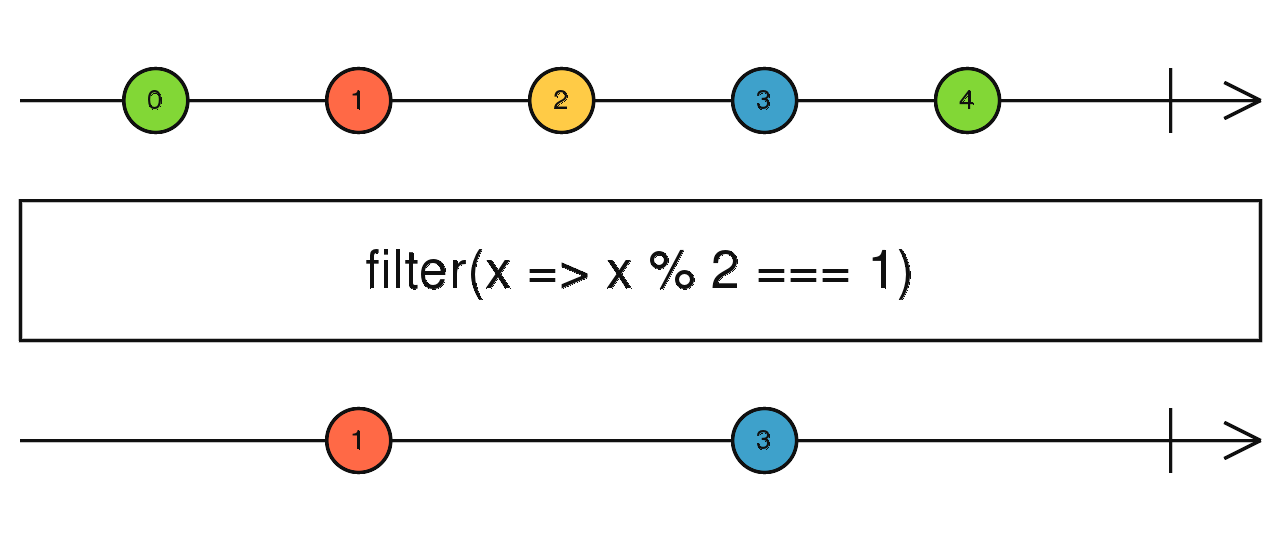
filter()is a built-in function that allows to process an iterable and extract those items that satisfy a given condition
filter(function, iterable)
- function - a function definition.
- iterable - a sequence (list, tupple, range or string) or container which supports iteration, or an iterator.
- Function should return a Boolean value. It is called for each item in the sequence and if it returns False, the item will be filtered
- Example: List of even numbers - without lambda
- Example: List of even numbers - with lambda
				def is_even(x):
					return True if x!=0 and x%2==0 else False

				even_numbers = filter(is_even, range(10))

				print( list(even_numbers) )

				# [2, 4, 6, 8]
				even_numbers = filter(lambda x: x%2==0 if x!=0 else False, range(10))

				print( list(even_numbers) )
More examples
- Example: filter empty strings
- Example: Names, starting with 'A'
- Note that we can use list comprehenstions insead of filter
				names = ["Ivan", "", "Alex", "", "Maria", "Angel", ""]
				not_empty_names = filter(lambda s: s, names)

				print( list(not_empty_names) )
				names = ["Ivan", "Alex", "Maria", "Angel", ""]
				filtered_names = filter(lambda s: s and s[0]=="A", names)

				print( list(filtered_names) )
				names = ["Ivan", "", "Alex", "", "Maria", "Angel", ""]
				not_empty_names = [ name for name in names if name]

				print( list(not_empty_names) )
The map() Function
The map() Function
Syntax
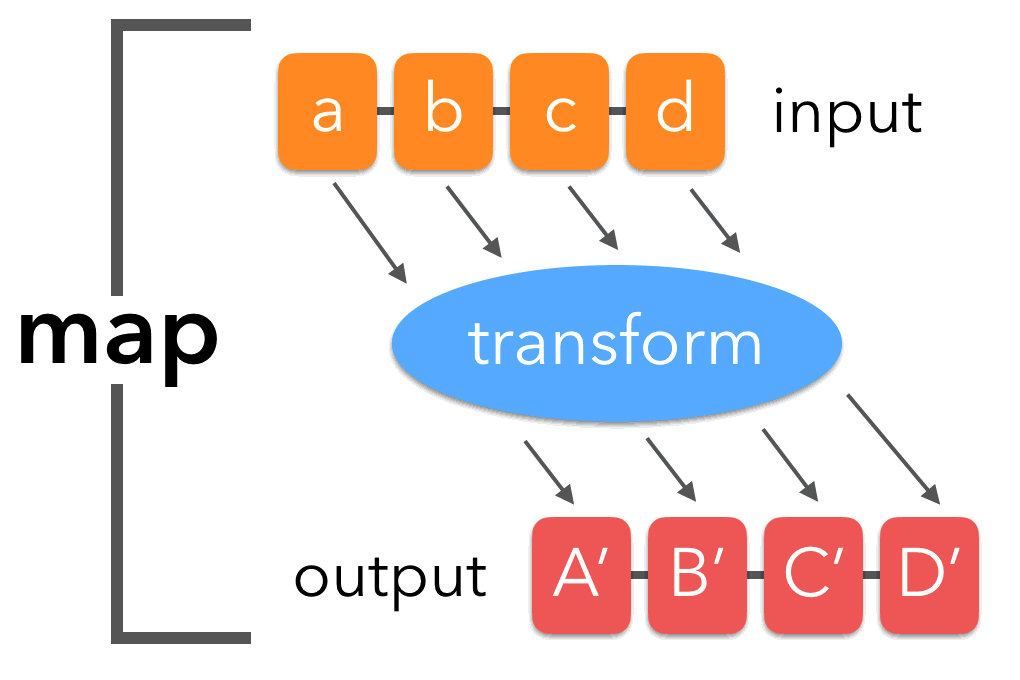
map()return an iterator that applies function to every item of iterable, yielding the results- function - a function definition.
- iterable - a sequence (list, tupple, range or string) or container which supports iteration, or an iterator. Note, that you can pass multiple iterables!
- map() applies the function to all the elements of the iterable. And returns a new iterable with the elements changed by the function.
- Example: map list of numbers to list of squared numbers
map(function, iterable, ...)
				numbers = [1,2,3,4,5]

				sqr_numbers = map(lambda x:x**2, numbers)

				print( list(sqr_numbers) )

				#[1, 4, 9, 16, 25]
Examples
- Example: Generate all uppercase cyrillic letters by their UTF codes
- Above example can be done with list comprehenstions, as well:
- Example: feed map() with multiple iterables. Note that this example can not be done easilly with list comprehensions
				letters = map(chr, range(1040, 1072))
				print( list(letters) )

				#['А', 'Б', 'В', 'Г', 'Д', 'Е', 'Ж', 'З', 'И', 'Й', 'К', 'Л', 'М', 'Н', 'О', 'П', 'Р', 'С', 'Т', 'У', 'Ф', 'Х', 'Ц', 'Ч', 'Ш', 'Щ', 'Ъ', 'Ы', 'Ь', 'Э', 'Ю', 'Я']
				letters = [chr(code) for code in range(1040, 1072)]
				print( list(letter

				#['А', 'Б', 'В', 'Г', 'Д', 'Е', 'Ж', 'З', 'И', 'Й', 'К', 'Л', 'М', 'Н', 'О', 'П', 'Р', 'С', 'Т', 'У', 'Ф', 'Х', 'Ц', 'Ч', 'Ш', 'Щ', 'Ъ', 'Ы', 'Ь', 'Э', 'Ю', 'Я']
				l1 = [1,2,3]
				l2 = [1,2,3]

				l_sum = map(lambda a,b: a+b, l1, l2)
				print( list(l_sum) )

				# [2, 4, 6]
The reduce() Function
The reduce() Function
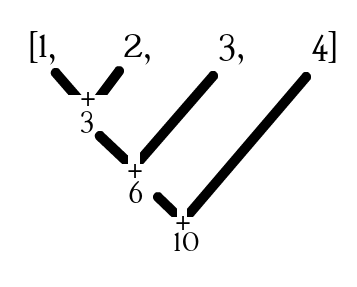
reduce()allows us to apply a function to an iterable and reduce it to a single cumulative value- In Python3, reduce() is not built-in, but we must import it from
functoolsmodule! - function - a function definition.The first argument passed to function is the accumulated value and the second argument is the update value from the sequence
reduce(lambda x, y: x+y, [1, 2, 3, 4, 5])calculates ((((1+2)+3)+4)+5)- iterable - a sequence (list, tupple, range or string) or container which supports iteration, or an iterator (will be discussed in further topics).
- If the optional initializer is present, it is placed before the items of the iterable in the calculation, and serves as a default when the iterable is empty
reduce(lambda x, y: x+y, [1, 2, 3, 4, 5], 100)calculates (((((100+1)+2)+3)+4)+5)
				from functools import reduce

				reduce(function, iterable[, initializer])
Examples
- Example: sum the numbers from 0 to 10, including
- Example: sum the prices of all products
				from functools import reduce

				res = reduce(lambda a,b: a+b, range(11))

				print(res)

				#55
				products = [
					{'name':'apples', 'price': 2},
					{'name':'oranges', 'price': 5},
					{'name':'bananas', 'price': 3},
				]

				#note that here we must provide initializer
				total_price = reduce( lambda curr_price, product:curr_price+product['price'], products, 0)

				print(total_price)
Example: map - reduce
- Often in practice filter, map and reduce are used in combination
- Consider next example, which returns the sum of variable number of lists items positionally
			l1 = [1,2,3]
			l2 = [1,2,3]
			l3 = [1,2,3]

			l = map(lambda *t: reduce(lambda a,b: a+b, t) , l1, l2,l3)
			print( list(l) )

			# [3, 6, 9]
Exercises
Task1: get_names_with_posistive_balance
The Task
- Create a list of all user names, which have positive balance
			users = [
				{'name':'Maria', 'balance': 2000},
				{'name':'Petar', 'balance': -189},
				{'name':'Ivan', 'balance': 3200},
				{'name':'Asen', 'balance': -2890},
			]

			# YOUR CODE here

			# EXPECTED OUTPUT:
			['Maria', 'Ivan']
Task2: map_filter_words_in_quotes
- Next list of Douglas Adams quotes is given:
- Write a program which will output in the console only the words that starts with letter 't' and are longer than 3 symbols
			quotes = [
				'Nothing travels faster than the speed of light, with the possible exception of bad news, which obeys its own special laws',
				'A common mistake that people make when trying to design something completely foolproof is to underestimate the ingenuity of complete fools.'
			]
			TRAVELS
			THAN
			THAT
			TRYING
These slides are based on
customised version of
framework